Written so the factory does not have to guess.
Tech packs, grading, trims, QC and the time-and-action - in the factory's own language, at the level of detail that stops a sample coming back wrong.
The size curve
One block, cut six ways.
Grading is not a percentage. The girths move 4cm a size and the shoulder moves 0.6cm, which is why a scaled photocopy of a pattern fits nobody.
| Size | EU | Bust | Waist | Hip | Shoulder |
|---|---|---|---|---|---|
| XS | 34 | 80.0 | 62.0 | 86.0 | 37.2 |
| S | 36 | 84.0 | 66.0 | 90.0 | 37.8 |
| Msample | 38 | 88.0 | 70.0 | 94.0 | 38.4 |
| L | 40 | 92.0 | 74.0 | 98.0 | 39.0 |
| XL | 42 | 96.0 | 78.0 | 102.0 | 39.6 |
| XXL | 44 | 100.0 | 82.0 | 106.0 | 40.2 |
The paperwork, for real
Open a tech pack. Then open the spreadsheet.
Construction callouts, a size curve with grading rules, trim cards, a fit report, an AQL plan and the T&A - page through each one here and download the file a factory would actually receive.
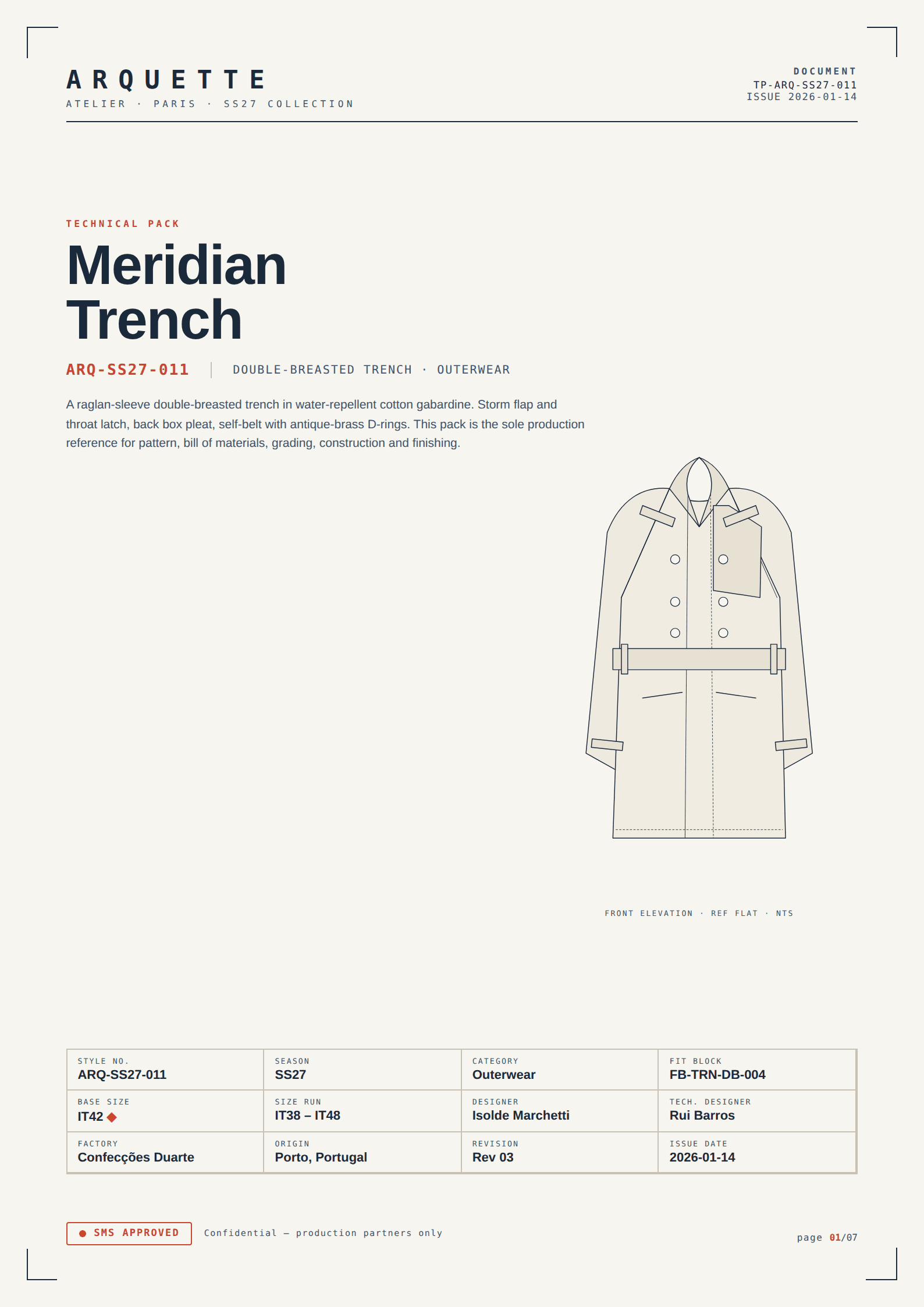
Technical Pack - ARQ-SS27-011 Meridian Trench
PDF · page 1 of 7
Switch deliverable
5 more like these - browse all 15.
Where a spec actually lives
A measurement is a band, not a number.
The gap between a beautiful design and a shipped garment is a stack of unglamorous documents, and it is where most small brands lose a season. The most common cause of a rejected sample is a spec that gave a target without a tolerance, so the factory hit the target on the sample and the mean on the bulk. The register runs from the tightest band to the loosest.
- Critical
- Neck, armhole, waist. Out of band and the garment does not fit anybody.
- Fit
- Chest, hip, rise. Out of band and it fits a different person than intended.
- Length
- Body, sleeve, inseam. Visible, forgiving, and the one customers return on.
- Detail
- Pocket placement, trim position. Reads as quality rather than as fit.
- Informational
- Recorded so a later season can be compared, not inspected against.

The tolerance register above is what stands between this and a bulk run that measures to the mean instead of the target. Nothing here is decided by eye.
The one job this page is about
Hand the factory a spec it can build from without a phone call.
- How often it comes round
- Every style, every development round, every handover.
- Skip it once
- The factory interprets the gaps, and the sample comes back wrong in a way that costs a whole round.
The problem
What this actually costs you.
You find the defect at final inspection.
By then it is made. Discount it, rework it, or miss the date - all three come out of margin.
What we do
The sampling plan, defect classes and lab package are set before the run, and the spec's risk is scored while it is still a spec.
- Fit-risk audit
- Marker and fabric-yield optimisation
- Pattern blocks and grading
The tech pack is right and the garment is wrong.
Fit is the biggest single driver of returns, and a size label is a marketing decision, not a measurement.
What we do
A package in the format a factory reads, graded to a real size curve, with fit risks named before a sample is cut.
- Fit-risk audit
- Pattern blocks and grading
- Print repeats and colourways
Every substitution reopens the costing.
A discontinued trim or a wasteful lay plan quietly moves the landed cost you already quoted.
What we do
Substitutions are checked on performance and price together, so the change arrives as a number.
- Fabric substitution
- Fibre commodity prices
- Marker and fabric-yield optimisation
What you open
The studios behind it.

What actually runs
Specifying, grading and inspecting are three trades, and a pack that confuses them is a pack that gets queried. One system, 102 tools and 222 playbooks behind it.
Handed to
- Production Specialist
- Materials Specialist
- Production Planner
- Fashion Designer
Get started
Try Production Specs AI
Bring a style and leave with the pack a factory can quote against.